

The Half-Million Design on a £100k Budget Dilemma - Practical Alternatives
In the field of controlled environment engineering, a persistent disconnect exists between project procurement teams and technical consultants. Across the United Kingdom, procurement officers and financial directors are frequently tasked with establishing high-tier cleanroom facilities to support new manufacturing lines. However, when these teams base their financial projections on standard industrial fit-out costs, they run into a major obstacle. Demanding an exceptionally clean space, such as an ISO Class 5 environment, while allocating a budget more suited to a basic warehousing conversion creates an engineered mismatch that can stall projects before they even begin.
This budgetary mismatch often stems from a lack of transparency regarding the cost drivers of contamination control. A cleanroom is not merely a collection of plastic walls and standard air conditioning units; it is a highly integrated, dynamic thermodynamic system.
When a budget is unaligned with physical engineering realities, the temptation to cut corners can lead to project failure. Fortunately, expensive, permanent structural builds are not the only way forward. By exploring modern modular alternatives and localized containment strategies, procurement professionals can achieve the exact classification their process requires without overextending their capital budget.
What Are the Real Cost Drivers in Cleanroom Engineering?
To bridge the gap between financial constraints and physical execution, it is essential to understand why cleanroom costs scale non-linearly. Increasing the cleanliness classification of a room by just one tier does not result in a minor incremental cost; it fundamentally alters the mechanical infrastructure required to support the space.
The Exponential Cost of Air Change Rates
The primary factor determining both the initial capital expenditure and the long-term operational cost of a facility is the required volume of clean air movement. This volume of air is carefully calculated to dilute the known particle burden rate just enough to achieve the specified classification. This volume of air can also be divided by the room volume to give a number of air changes per hour (ACH). This metric is a popular way to describe the level of dilution.
Why Over-Specifying Classification Destroys Budgets
A standard unclassified office building experiences roughly two to four air changes per hour. The amount of air required in each cleanroom will depend on the particle burden rate generated by the process, people and equipment in the cleanroom. If you know your burden rate the air volume required is a simple mathematical equation. If you do not have the data to calculate the particle generation then you are relying on your designers experience on similar processes or in a worst-case scenario a complete gamble with a guess at an air change rate that you think might do the trick.
You will not find specified air changes rates in any of the 20+ parts of ISO 14644, EU GMP Annex 1 makes reference to an air change rate of ‘more than 20’ which is also referenced in the American FDA
However, a quick Google search will throw air change rates for an ISO Class 5 classification of anything between 240 and 480 ACH.
“I have tested repeatedly ISO 5 environments with air change rates below 100 ACH” says Toni Horsfield CTCB-I Professional.
If 480ACH had been specified, the air handler would to move up to five times more air volume every single hour. To support this velocity, up to five times the amount of HEPA or ULPA filters would be required (a consumable cost), and the mechanical plant room must expand to house massive air handling units. Over-specifying a room out of lack of data or caution, rather than strict process necessity, can instantly break a project budget.
The Operational Cost of High-Volume Airflow
The financial strain of high air change rates extends far beyond the initial build phase. Moving large volumes of air continuously requires significant electrical power to run the HVAC equipment and/or fan filter units (FFUs). The final filters (HEPAs or ULPAs) are much finer/denser filters compared to general commercial space filters which create a substantial static pressure load, forcing the fan motors to consume more energy.
Environmental set points and their effect on budget
Briefs often include a temperature and/ or humidity set point and a permitted tolerance. The tighter the tolerance is set to the set point the greater the complexity and therefore the cost and size of the HVAC equipment required. When you factor in the utility costs required to constantly chill, heat, and dehumidify this massive air stream, an over-specified facility can cost tens of thousands of pounds more in annual electrical bills alone, permanently denting operational profitability.
Structural Architecture and Mechanical Infrastructure
Beyond the fans and filters, the physical materials required to build a permanent cleanroom demand specialist installation practices that carry a premium price tag.
Heavy Structural Modifications
If the design calls for modifying the existing brick-and-mortar building fabric, additional trades are required increasing the labour expense. Works can require reinforcing the floor to support heavy structural columns, installing extensive ceiling suspension grids to hold ductwork arrays, and rerouting primary facility utilities. These structural interventions can require extensive civil engineering labour, detailed building surveys, and lengthy lead times, all of which drive up cost metrics.
Plant Room Footprint Expansion
A traditional cleanroom requires a substantial amount of hidden square footage to house its supporting mechanical infrastructure. Massive air handling systems, chilled water loops, boilers, and control panels cannot be placed within the clean zone itself. They require a dedicated, secure plant room. Allocating valuable factory floor space to a plant room reduces the available area for revenue-generating production machinery, creating an expensive secondary cost that is often overlooked during early budgeting phases.
Regulatory requirements
Once a cleanroom project reaches certain criteria the HSE need to be notified about the building site and an F10 form will need to be filed. To comply with the HSE the site must have a dedicated principal designer and a principal contractor, both of these roles carry significant legal responsibilities to the health and safety of all of those working on the build and to fulfill these requirements additional staff are usually required.
Depending on the nature and extent of the cleanroom design, building regulation approval may need to be sought which may also require the services of a Building regulation principal designer.
Comparing the Cost-to-Benefit Profiles of Cleanroom Solutions
When facing a strict budget limit, procurement teams must evaluate alternatives to traditional construction. Modern cleanroom design offers several distinct tiers of structural complexity, each with its own specific cost profile and performance envelope.
Solution Type
| Solution Type | Capital Cost Profile | Lead Time Matrix | Flexibility / Relocation | Maximum Attainable ISO Class |
| Traditional Structural Build | Very High (££££) | 12 to 24 Weeks | Permanently Fixed | ISO Class 4 to ISO Class 9 |
| Modular Panelling System | Medium to High (£££) | 6 to 10 Weeks | Disassemble & Reconfigure | ISO Class 5 to ISO Class 9 |
| Portable Softwall Enclosure (Localised Micro-Environment) | Low to Medium (££) | 4 to 6 Weeks | Can be Highly Mobile on Castors | ISO Class 4 to ISO Class 9 (NB. No pressure; not a stand-alone cleanroom) |
| Cleanroom Tent | Low (£) | 1 to 2 Weeks | Highly mobile. Disassemble and relocate in a matter of hours | ISO Class 6 to ISO Class 8 |
| Separative Devices | Minimal (£) | 4 to 6 Weeks | Benchtop / Desktop Modular | ISO Class 4 to ISO Class 8 |
Traditional Full Structural Cleanrooms
Traditional builds represent the most permanent approach to environmental control. Constructed using block work or heavy-duty partitioning which is then clad in a wipe clean covering, integrated epoxy resin floors, and custom-engineered air handling units with extensive HVAC ductwork networks, these facilities offer exceptional durability and a sleek aesthetic.
However, this permanent architecture offers very little adaptability. If your production requirements change next year, expanding or moving a traditional structural cleanroom requires full demolition work, completely wasting your initial capital investment. For companies operating in fast-moving industries like medical device assembly or contract electronics manufacturing, this rigidity represents a significant commercial risk.
Modular Panelling Systems
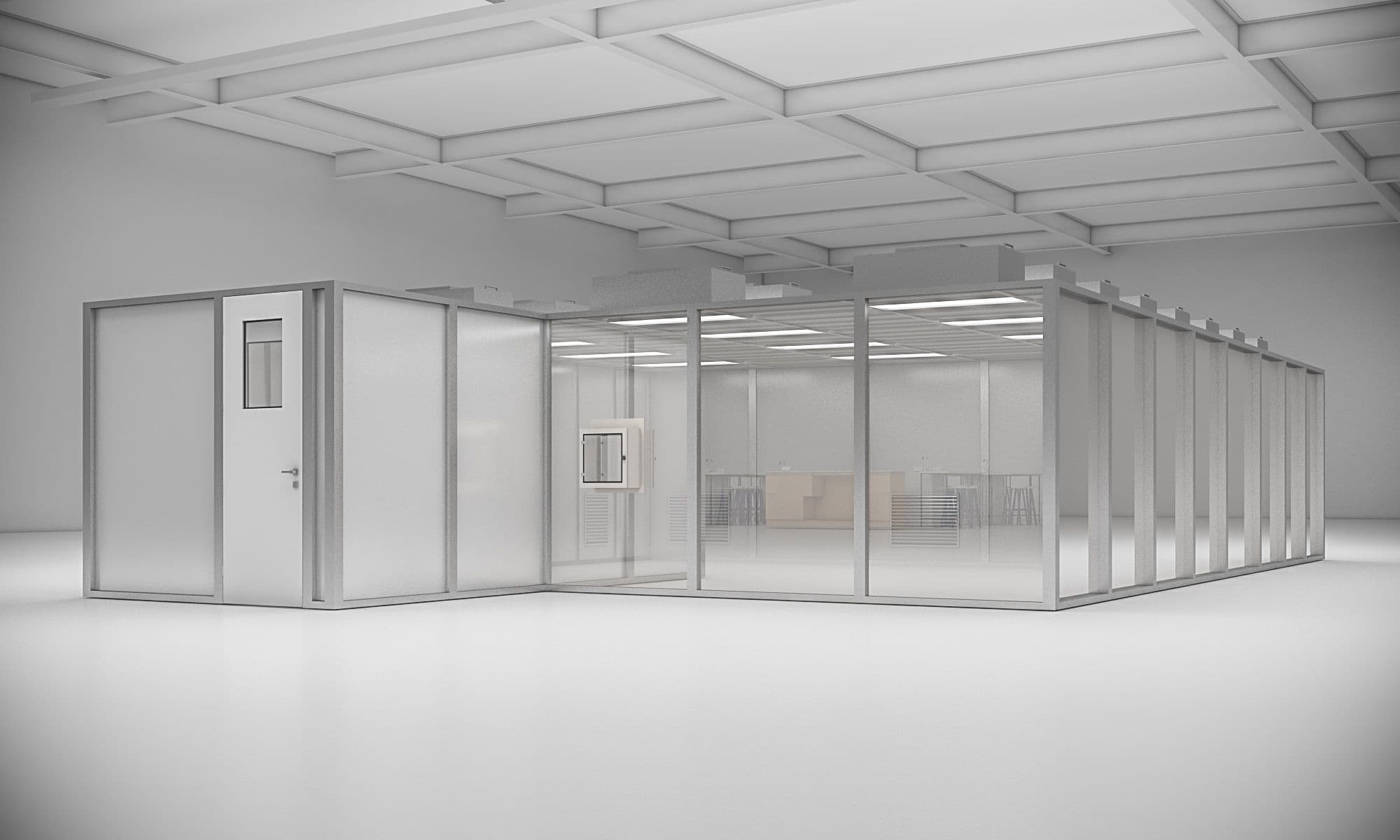
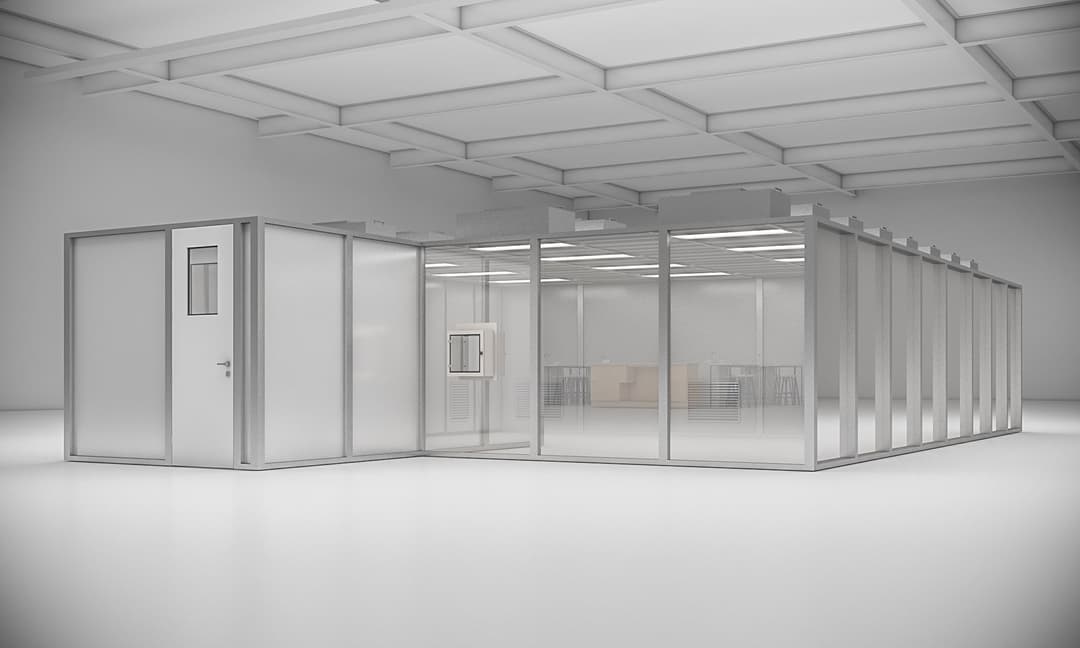
Modular panelling systems provide a highly effective alternative to traditional construction. These systems use prefabricated, interlocking wall sections constructed from non-porous materials like aluminium honeycomb or high-density composite panels, which assemble quickly on an internal tracking framework.
Because these components are pre-manufactured to precise measurements off-site, on-site installation times are cut by up to fifty percent. This significantly reduces on-site contractor labour costs and minimises production disruption.
Most importantly, modular systems can be disassembled, expanded, or relocated to a completely different area of your facility as your business grows. This adaptability turns a one-time construction expense into a long-term asset.
Portable Softwall Enclosures
For zoned classifications portable softwall enclosures offer an excellent way to achieve localized compliance quickly. These structures use a lightweight, freestanding stainless steel or anodised aluminium framework fitted with overlapping, clear anti-static PVC strip curtains.
Air filtration is handled by self-contained, ceiling-mounted FFUs that draw air from the surrounding host cleanroom, pass it through terminal HEPA filters, and push it downward to create a positive pressure canopy.
Because these enclosures can be mounted on heavy-duty lockable castors, they can be rolled directly over specific assembly machinery when needed and rolled away for maintenance. This mobility eliminates the need for expensive structural design validation and architectural changes.
Cleanroom Tents
For projects with limited capital, R&D projects and proof of concept projects a portable softwall cleanroom tent offers an excellent way to achieve localized compliance quickly. These tents are a complete sealed envelope maintaining a positive pressure with integrated gowning air locks.
The materials are light weight and so easy to ship to remote sites and are designed for quick and easy assembly.
Separative Devices
When analysing process lines, engineers often find that while the entire component assembly loop takes place across a large factory floor, only a tiny fraction of that process is truly sensitive to airborne contamination. In these scenarios, building a full room to protect a small process is financially inefficient.
Instead, companies can deploy a specialised HEPA enclosures. There are many on the market, Laminar flow benches/hoods or localised clean storage lockers all of which provide a clean environment directly at the point of vulnerability. These compact micro-environments maintain an isolated, high-classification air envelope right over the product workspace or storage shelf. This approach allows the surrounding warehouse to remain unclassified, drastically reducing both initial capital expenditure and ongoing power consumption.
Where Can Procurement Safely Optimise the Budget?
Optimizing a cleanroom budget requires strategic engineering trade-offs. It is entirely possible to reduce overall project costs significantly without compromising the legal compliance or validation success of your manufacturing line.
Implementing Zoned Classifications
The most effective method for reducing cleanroom costs is the application of zoned classifications, rather than treating the entire facility as a single uniform space.
Instead of engineering a large, hundred-square-metre room to hit a strict ISO Class 5 standard, a smart design utilizes a nested layout. The main room can be engineered to a less demanding ISO Class 7 standard for material prep, and general assembly, with an ISO 8 gowning, with a modest air change rate and minimal FFU infrastructure.
Then, directly over the critical inspection or packaging station, you install a localized ISO Class 5 unidirectional micro environment. This nested approach ensures your product receives maximum protection where it matters most, while reducing total project component costs by tens of thousands of pounds.
Using Prefabricated Modular Architecture
Choosing modular panelling networks over custom stick-built plasterboard designs yields immediate structural savings. Modular components arrive pre-finished, eliminating the need for on-site plastering, sanding, and epoxy painting, all of which introduce high labour costs and cleanroom contamination risks during construction. Additionally, modular panels can feature integrated internal raceways for electrical wiring and gas services, reducing the time specialized trade contractors need to spend on-site during installation loops.
Where Will Cutting Corners Guarantee Validation Failure?
While saving money on walls and structural frames is smart practice, the correct structure is still vital to the success of the project. Starting with the right data about particle generation, heat loads and moisture loads will ensure you have the correct HVAC design. Guessing in these critical areas could cause your facility to fail its initial testing protocols, rendering the entire investment useless.
Skimping on the Mechanical HVAC Handling Unit
The air handling unit is the operational heart of any cleanroom facility. Attempting to save budget by installing cheap, could make future maintenance a difficult job or in the worst case not possible. A well-designed cleanroom will allow for easy access to all mechanical elements and filters.
Failure to Maintain the Pascal Gradient
Good HVAC design ensures that the units specified are able to overcome the high static resistance of terminal HEPA filters at the end of the HEPA life, not just when they are brand new. As the filter face blinds, the pressure increases. If the fans are not able to maintain the required face velocity you will not be able to maintain the precise air pressure cascades needed to protect the space.
Without this stable Pascal gradient, open doors will allow dirty air from adjacent changing zones to rush back into the cleanroom floor, immediately invalidating your airborne particle counts and causing validation failure.
Inadequate Latent Moisture Extraction
Cheap cooling hardware lacks the precise control loops required to independently manage sensible heat and latent moisture. During humid summer months, these basic units often fail to drop the air temperature low enough to reach its dew point, leaving the air damp and clammy. This leads to immediate operational issues, causing operators to overheat inside their gowning layers and introducing significant microbial contamination risks from sweat.
Using Non-Cleanroom Grade Construction Materials
Using standard industrial materials to save money on wall partitions or flooring is another common error that leads directly to validation failure.
Particle Shedding from Standard Materials
Standard industrial plasterboard, commercial ceiling tiles, and standard polymer paints are physically unstable under continuous high-velocity airflow. Over months of operation, the constant friction from the air handles strips micro-particles from these surfaces, shedding thousands of particulates straight into the room atmosphere. This material degradation can easily push particle counts far beyond ISO limits.
Cleanrooms require daily cleaning using various chemical agents, standard building materials are simply not designed to withstand this level of cleaning. Any material that sheds particles upon impact is fundamentally unsuitable for use within a cleanroom environment.
Chemical Outgassing and Delamination
Standard construction adhesives, caulking materials, and standard floor coatings often release significant volumes of volatile organic compounds (VOCs). In industries like micro-electronics or optical manufacturing, this chemical outgassing can ruin product surfaces.
How Do You Secure an Accurate Turnkey Quote for Your Budget?
Navigating the delicate balance between financial constraints and physical engineering parameters requires a professional, collaborative approach. Attempting to design a clean space without specialist oversight often results in costly design revisions, blown budgets, and failed validation testing. Long-term operational success demands an engineered solution that prioritises your critical process requirements while choosing the most cost-effective architectural format.
At ISO Cleanroom, we provide complete, bespoke cleanroom solutions across the United Kingdom to help businesses overcome complex budgetary and engineering challenges. Our experienced team can audit your manufacturing lines, help you implement strategic zoned classifications, and deliver tailored modular setups, portable softwall tents, or localized HEPA enclosure networks. We focus on optimizing your capital expenditure, ensuring you secure a fully compliant, validated space that matches your specific financial targets.
Whether you need a full turnkey cleanroom build, an upgrade to your existing filtration infrastructure, or a professional validation review, our engineers are here to assist. We design, manufacture, and install high-performance facilities that align with the rigorous compliance frameworks of ISO 14644-1 and EU GMP, giving your team complete operational confidence.
To discuss your project requirements and secure a detailed, transparent turnkey quote that aligns perfectly with your business budget, please get in touch with our team today. Visit our dedicated contact page to submit your project metrics, or explore our specialized cleanroom design portfolio to discover how our adaptable modular frameworks can support your next facility upgrade. You can also review additional regulatory guidance via the International Organisation for Standardisation (ISO) and the British Standards Institution (BSI) portals to study the global engineering standards that guide our custom manufacturing work.
