

Why Cleanroom Gowning is Essential
Cleanroom gowning matters because people are the biggest source of contamination in a cleanroom, and gowning is what contains the skin, hair, and droplets we shed every second we are inside. Without it, no amount of filtration or air handling will hold the room's classification. Get the garments and the discipline right and the room performs. Skip them, and the process you are protecting is already compromised.
I hear resistance to cleanroom garb regularly, and it is not surprising. During a warm summer, like this year in 2026, while everyone else enjoys the outdoor life, operators are covered head to toe in an extra layer or two of PPE: overshoes or boots, coveralls, gloves, hairnets, beard snoods, masks, and goggles. Many are working on intricate tasks that would be far easier without gloves. The discomfort is real, so the case for gowning has to be just as real.
What bare hands do to a particle counter
The quickest way I have found to answer those in doubt is to show them. With new users I run a simple demonstration using our particle counter. Rub two clean, ungloved hands together above the sensor and the reading spikes into the millions. Nothing has been touched, nothing looks dirty, and yet the count tells the true story of what a bare hand releases into the air.
At exhibitions we have turned this into a challenge. We place a £50 note inside a portable cleanroom, uncommissioned, and offer it to anyone who can reach the money without PPE and without setting off the particle counter. Some try a slow, stealthy approach, others gamble on being quick enough to beat the laser. My money has always been very safe. The point lands every time: a human being cannot enter a controlled space quietly, because the body is broadcasting particles constantly.
The skin we shed
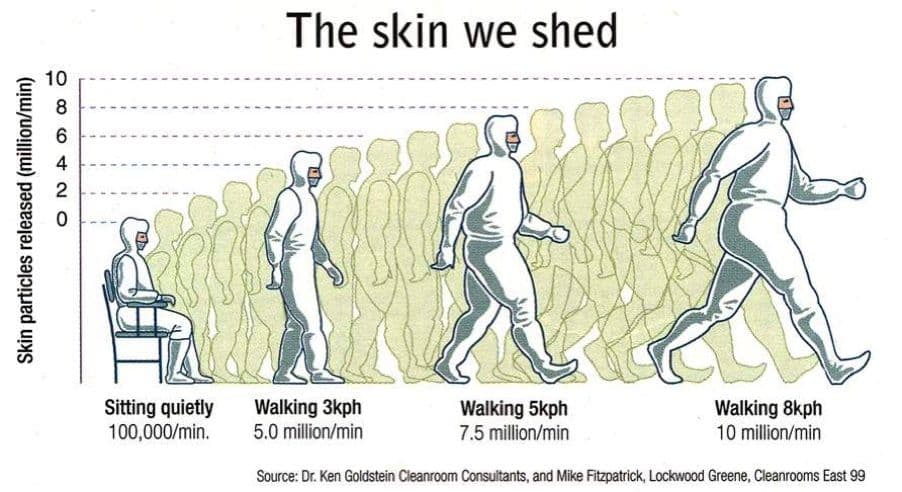
Every one of us sheds a remarkable amount of particulate, and how we move changes the number dramatically. All ISO Cleanroom designers, project managers, and testers are fully trained, and we take continuing professional development seriously. A colleague and I recently completed a cleanroom validation course, and one slide stayed with me: it laid out both how much particulate the human body releases and how sharply that figure rises as movement gets faster.
That second part is the piece most people miss. A person standing still sheds a baseline of particles. The same person moving quickly sheds far more, and a rushed operator drags a small vortex of air behind them that lifts settled particles back off surfaces. Faster movement increases contamination. Slow, deliberate movement reduces it. Gowning contains what the body gives off, and calm behaviour keeps the rest of it down.
Gowning protects the product and the person
Gowning is the first line of defence in cleanroom contamination control. Correctly worn cleanroom attire captures the skin cells, hair, fibres, and respiratory droplets that would otherwise reach the product, and in industries where a single particle can ruin a semiconductor wafer or a sterile injectable, that barrier is the difference between a good batch and a loss.
The protection runs in two directions. Cleanroom clothing shields the process from the operator, and it also shields the operator from the substances handled inside the room. In pharmaceutical and biotechnology settings, where sterility and worker safety carry equal weight, that dual role is why gowning is treated as non-negotiable rather than a formality.
Your risk assessment sets the requirement
While a generic set of cleanroom garb can be matched to a given ISO class, the PPE your process actually requires is determined by your risk assessment. Particulate cleanliness is governed by ISO 14644, and sterile and aseptic pharmaceutical manufacturing carries the added requirements of EU GMP Annex 1, but the standard is the floor, not the answer. A demanding process, a hazardous material, or an electronics application needing electrostatic discharge (ESD) protection can all push the requirement beyond the baseline for the class.
Wearing the right garments is only half of it. Putting them on in the correct order, so the clothing itself stays uncontaminated, is the other half, and that method is set out in full in our cleanroom gowning procedure. The wider operational discipline sits within ISO 14644-5, the international standard for cleanroom operations.
So to anyone who still thinks it is fine to just pop into the cleanroom for a moment: the alarm bells are ringing, and the particle counter can hear them.
Essential Cleanroom Gowning FAQs
People are the biggest source of cleanroom contamination, generating up to 80% of the particles a cleanroom has to control. The human body sheds skin cells and hair continuously and exhales fine particles, which is why gowning and personnel discipline matter more than any other single control.
You prevent contamination in a cleanroom by controlling every source at once: gowning staff correctly, filtering and pressurising the air, cleaning and disinfecting surfaces on a schedule, screening incoming materials, monitoring the environment, and training people to move slowly and behave correctly. The controls reinforce each other, so a gap in one weakens the rest.
HEPA filters remove airborne particles of 0.3 microns and larger, while ULPA filters remove finer particles of 0.12 microns and larger. HEPA filtration suits ISO 7 and cleaner rooms, and ULPA filtration is reserved for the most demanding classes, typically ISO 5 and below.
Positive pressure stops contamination by keeping the cleanroom at a higher pressure than the spaces around it, so air always flows outward and unfiltered air cannot leak in. Arranging rooms and anterooms into a descending pressure cascade pushes contaminants away from the cleanest zone.
A cleanroom should be cleaned on a defined schedule that combines daily surface wipe-downs with deeper periodic cleaning, all recorded in the site's SOP. The exact frequency depends on the room's ISO class and process, and the effectiveness of the routine is checked through environmental monitoring.
You should wear non-shedding cleanroom attire matched to the room's ISO class, which can include hooded coveralls, a hair net or hood, face mask, goggles, gloves, and dedicated footwear or overshoes. Electronics environments add ESD garments to drain static that could damage components.
By Tony Horsfield, director and CEO of ISO Cleanroom and a registered CTCB(I) cleanroom testing professional.
