



ISO Cleanroom Design and Build: Key Insights from the Cleanroom Technology Conference
An ultra-low humidity cleanroom, often called a dry room, combines the particle control of a traditional cleanroom with extremely low moisture content in the air, far below normal cleanroom humidity.
At its most recent meeting, the UK Cleanroom Technology Standards committee set out plans for work in this area and is inviting contributions from interested parties.
So, what are ultra-low humidity cleanrooms?
These environments are engineered to minimise not only particles, but also water vapour. Moisture levels are often expressed as very low relative humidity, such as less than 1% RH, or as a very low dew point, such as -30°C dew point or lower, depending on the process.
Achieving this type of environment is crucial where water vapour could chemically react with materials or compromise sensitive processes, including:
Advanced Battery Manufacturing: Lithium-ion and solid-state battery production require environments with extremely low moisture to prevent lithium and electrolyte reactions, helping ensure product quality and safety. Ultra-low humidity dry rooms often aim for dew points below -40°C to -60°C, or RH below 1%.
Semiconductor and Microelectronics Fabrication: Low humidity is used to minimise condensation, which can damage circuits.
Optics, Micro-Electro-Mechanical Systems and Nanotechnology: Moisture can affect coatings, etching and bonding steps at very fine scales.
Pharmaceutical Drying and Specialised Chemical Processes: Some chemical and powder processes require ultra-dry conditions to prevent clumping or unwanted reactions.
Current Standards Relevant to Ultra-Low Humidity Cleanrooms
As with all cleanrooms, the ISO cleanroom classifications most relevant to ultra-low humidity cleanrooms are set by the international standard ISO 14644, specifically:
- ISO 14644-1: For airborne particle counts per volume.
- ISO 14644-4: For the design and construction of cleanrooms.
For a broader explanation of how different classifications apply to different processes, ISO Cleanroom has also published guidance on cleanroom classifications and choosing the right standard.
Other Industry and Process Controls
- ASHRAE Guidelines: HVAC standards, such as ASHRAE 170 for specialised healthcare spaces and ASHRAE Handbook recommendations, guide system design that contributes to achieving the environmental control targets set by ISO or process requirements.
- ASHRAE Technical Committee 9.9: Mission Critical Facilities, Data Centres, Technology Spaces and Electronic Equipment, is responsible for developing guidance on environmental conditions and HVAC design for data centres and other spaces housing IT and electronic equipment. It is best known for its “Thermal Guidelines for Data Processing Environments,” which define recommended and allowable envelopes for temperature and humidity, including dew point and relative humidity limits.
Sector Regulatory Standards
- EU GMP Annex 1 / PIC/S / FDA: Pharmaceuticals: For controlled manufacturing, humidity and other parameters are specified according to product safety and quality as part of good manufacturing practice.
- Semiconductor Industry Standards: Companies often adopt industry best practices, such as SEMI standards, in addition to ISO cleanroom classification for humidity, particle monitoring and ESD control.
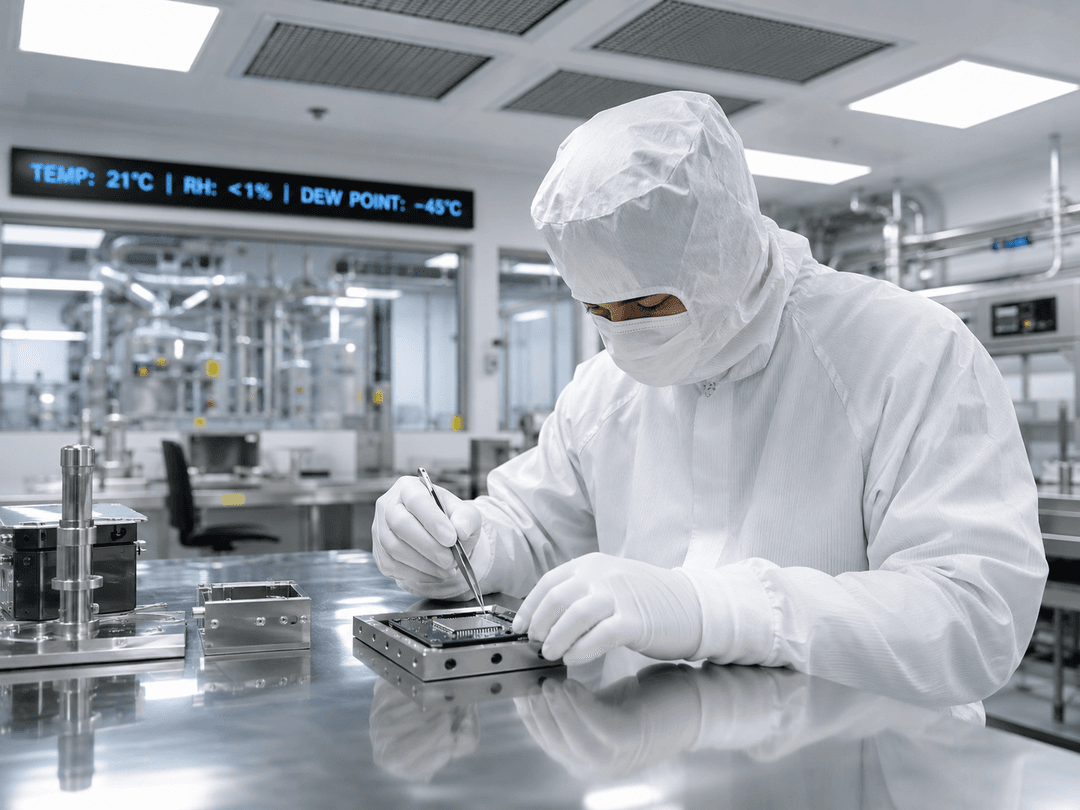
Core Design Features and Technologies for Ultra-Low Humidity Cleanrooms
To achieve both cleanroom particulate standards and ultra-low humidity, these spaces require specialised design choices beyond typical HVAC. ISO Cleanroom’s cleanroom design team works with clients to define process requirements, environmental controls, airflow, filtration and monitoring needs before construction begins.
Air Handling and Filtration
- HEPA / ULPA Filtration: High-efficiency filters are classified under BS EN 1822-1:2019 at the Most Penetrating Particle Size, or MPPS, the diameter at which the filter medium performs at its worst. MPPS typically falls between 0.12 µm and 0.25 µm and varies with the medium and the face velocity. It is not a cut-off: capture efficiency rises again for particles both larger and smaller than MPPS. H14 achieves at least 99.995% efficiency at MPPS, U15 at least 99.9995% and U16 at least 99.99995%. From H14 upwards, every element is individually scan-tested for local penetration as well as overall efficiency and supplied with its own certificate. Be wary of any datasheet quoting efficiency "at 0.3 µm", which uses the test basis of the 1956 American military standard MIL-STD-282 rather than the current European and international method. We cover filter class selection in more detail on our semiconductor and electronics cleanrooms page, and supply H13, H14 and U15 filtered enclosures where a full room is not required.
- High Air Change Rates and Laminar Flow: To maintain cleanliness and humidity homogeneity, vertical laminar airflow or engineered turbulent flow patterns are used.
Humidity Control Systems
- Desiccant Dehumidification: Desiccant dehumidification is often required to achieve very low dew points, such as -40°C or lower, beyond the capability of cooling-coil-based dehumidification. Desiccant systems absorb moisture and are standard in battery dry rooms. For further reading on humidity control challenges in controlled environments, see ISO Cleanroom’s article on cleanroom HVAC humidity control.
- Dew Point Monitoring and Controls: Systems continuously measure and control dew point and RH with tight feedback loops to resist moisture ingress from personnel, materials and equipment.
- Redundant Control Loops and Alarms: To maintain ultra-low humidity, multiple sensors and fail-safe systems help prevent excursions.
Envelope and Construction
- Airtight Room Envelope: Reducing infiltration from adjacent areas and outside air is essential. The cleanroom shell is sealed to minimise moisture entry.
- Airlock Entry and Exits: Airlocks help control moisture transfer as people, materials and equipment move in and out of the controlled space.
HVAC Integration
Precision HVAC Design: Temperature and humidity control are integrated. Cooling coils pre-condition air, while dehumidification systems eliminate moisture. Supply air dew point often needs to be even lower than the target room condition to offset internal loads.
Static and ESD Control: Very low humidity increases the risk of electrostatic discharge, so ESD-safe flooring, grounding and ionisation systems are included to protect sensitive electronics.
Where Next?
Latest research trends and innovations in this area include AI-driven predictive control, 3D-printed passive moisture regulation and advanced adsorption technologies that significantly improve energy efficiency.
Passive Humidity Regulation via 3D Printing: Researchers are developing 3D-printed, superhygroscopic geopolymer tiles for surface finishing. These tiles offer high surface area-to-volume ratios for passive moisture buffering, which can improve indoor hygrometric comfort by up to 85% and reduce reliance on mechanical dehumidification by up to 70%.
AI-Powered Humidity Control: Artificial intelligence is being integrated with IoT sensors to analyse data and predict potential moisture deviations before they occur. These algorithms optimise the operation of desiccant wheels and HVAC systems, reducing energy consumption.
Advanced Desiccant Technology: Research into Metal-Organic Frameworks, or MOFs, as desiccant materials is enabling higher moisture removal efficiency. A study on MOF-coated heat exchangers reports that MOF coatings, including MIL-100(Fe) and MIL-160(Al), can improve dehumidification rate and moisture removal efficiency compared with traditional silica gel.
The same research also supports the potential for MOF-based systems to separate latent moisture loads from sensible cooling loads, reduce HVAC energy consumption, and operate at lower regeneration temperatures.
Membrane Dehumidification: New membrane technologies are emerging to selectively remove water vapour from air streams. These systems can achieve the required ultra-low humidity levels at approximately 50% of the energy demand of conventional systems.
Graphene Oxide Humidity Sensors: New sensor developments in 2024 and 2025, such as graphene oxide and perovskite-based sensors, offer sub-second response times and reduced calibration drift, from 3% to 0.5% over six months. This improves the reliability of monitoring systems in extreme environments.
A recent overview of industrial humidity control technologies also highlights developments in perovskite and graphene oxide humidity sensors for applications requiring fast response and improved long-term stability.
Hybrid Systems: Modern systems are increasingly combining two-stage desiccant rotors with pre-cooling, allowing for deep dehydration while minimising energy consumption. A 2023 study showed that pre-cooling air in a dew point evaporative cooler before it reaches a desiccant rotor significantly increases efficiency.
These innovations aim to reduce the high energy costs associated with maintaining ultra-low humidity in large-scale facilities while improving environmental stability and precision.
ISO TC209 Cleanrooms and Associated Controlled Environments
As mentioned earlier, the agenda for the UK Cleanroom Technology Standards committee LBI/030, held in mid-November last year, also turned the spotlight on ultra-low humidity cleanrooms, with a focus on how this specialism could be developed in the future.
The committee is welcoming comment about low-humidity operations, as well as the following areas:
Negative Pressure Cleanrooms
Negative pressure cleanrooms are becoming a more frequent requirement to address microbiological and toxic chemical hazards. Pharmaceutical GMPs and safety regulations are silent about design, construction and testing or qualification requirements, raising the question of what recommendations could be made.
Robots and Robotic Applications
Robots and robotic applications are now frequently considered to automate critical processes, alleviate repetitive tasks and help reduce human-derived contamination.
Guidance needs to be developed in ISO to provide information and improve understanding of the application of current cleanroom suitability standards EN ISO 14644-14 and EN ISO 14644-15: https://www.iso.org/standard/60970.html
ISO Cleanroom has also explored the human factor in cleanroom operation, including communication, training and behavioural compliance.
Biofluorescent Particle Counters
The final piece of new work concerns biofluorescent particle counters, or BFPCs.
These are advanced instruments that detect and count airborne biological particles, such as bacteria and fungi, in real time using laser-induced fluorescence. They offer a faster, automated alternative to traditional culture-based methods in pharmaceutical cleanrooms for environmental monitoring.
Standards are already being developed to address calibration, but information and guidance are also needed on applications, particularly in the life-science sector.
ISO Cleanroom has also published further guidance on particle counters and real-time viable monitoring.
Committee Chair Gordon Farquharson has asked anyone interested in, or able to contribute to, this important work to contact simran.lamgani@bsigroup.com.
ISO Cleanroom founder and Director Toni Horsfield said:
We always say our industry never stands still, and some of these very specialised areas are a case in point. There is always new thinking, new developments and the chance to get involved in the debate. I particularly value the way we can work together and learn from different people’s experiences to move things forward. The Contamination and Control Network website is home to the forum for debating these and other topics with industry leaders like Gordon and many others. Anyone that is interested can find it here: https://theccnetwork.org/
To connect with Toni at ISO Cleanroom:
or email sales@isocleanroom.co.uk.
By Tony Horsfield, director and CEO of ISO Cleanroom and a registered CTCB(I) cleanroom testing professional.
